Why Do SPC Flooring and Stair Treads Have Color Variations?
 Are Foam PVC Rolls Suitable for Home Use?
 Why SPC+IXPE Outperforms SPC+EVA, LVT & Bare SPC?
 How Is SPC Flooring Packed for International Shipping?
Polyvinyl chloride, chlorinated polyethylene, and chlorinated polyvinyl chloride can all be in the state of white powder, and they are visually very similar. This article aims to introduce the characteristics of these three.
▷Introduction to polyvinyl chloride
Polyvinyl chloride (PVC), which is polymerized by monomer vinyl chloride according to the free radical reaction mechanism, has a chlorine content of 56.7%. It is mainly synthesized by suspension method, and there are also emulsion method and bulk method. Its molecular formula is as follows. One of the general-purpose resins (others are PE, PP, PS, ABS), with its excellent insulation performance, flame retardancy and chemical stability, it is widely used in the fields of automobiles, building materials, cables, packaging and so on.
Due to the presence of chlorine, the polarity of the molecule is increased, and the intermolecular interaction is enhanced, so that the hardness, rigidity and mechanical properties of PVC products are better, and the mobility of the molecules is poor, showing the characteristics of brittleness and hardness. Poor impact resistance and poor toughness; under alkali, light, and heat conditions, hydrogen chloride will be released to form double bonds. With the release of hydrogen chloride and adjacent chlorine atoms, more and more conjugated double bonds will be produced, and the color of the material will change from light to dark. Easier to be oxidized and degraded or cross-linked.
The substance is an amorphous polymer with a crystallinity of 5-10%, a high melting point, and poor thermal stability. It can only be processed at a temperature that retains certain crystallization. The fluid viscosity is high and the processing performance is poor.
Therefore, practical PVC materials are all modified, such as adding stabilizers to stabilize chlorine atoms, plasticizers to soften them, and anti-impact agents to improve their mechanical properties.
▷Brief Introduction of Chlorinated Polyethylene
Chlorinated polyethylene is the product of high-density polyethylene after chlorination substitution reaction, and the distribution of chlorine atoms is more random. As the chlorine content increases, the state changes from a thermoplastic to a rubber-like material, which becomes closer to leather, becoming harder and more brittle.
Chlorinated polyethylene has similar properties to polyvinyl chloride. If it has better chemical stability and flame retardancy, it will also decompose to produce hydrogen chloride, but its toughness and anti-aging performance are better. Compared with other polymer materials good compatibility.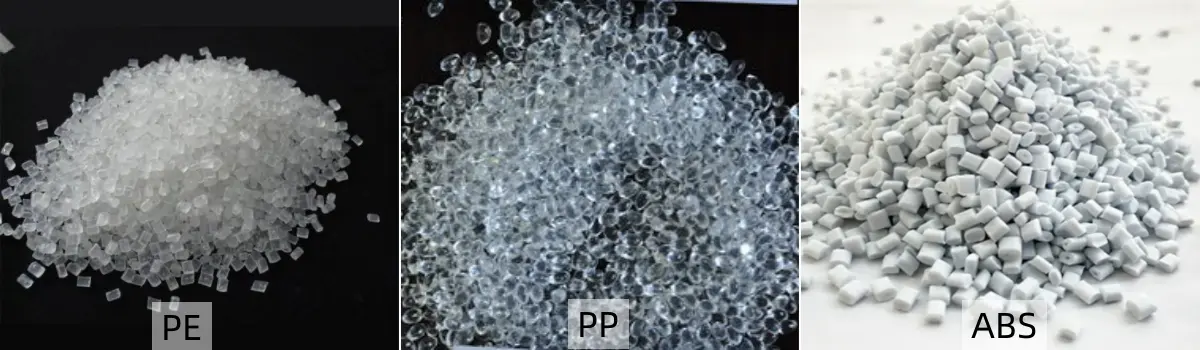
Therefore, it can be used as an impact resistance improver for polyvinyl chloride, and can be blended with PE, PP, ABS, etc. to improve their aging resistance, flame retardancy, and printability. It is also a synthetic rubber with good comprehensive properties.
▷Brief Introduction of Chlorinated Polyvinyl Chloride
Chlorinated polyvinyl chloride (CPVC), also known as perchlorethylene, is the product of further chlorination of polyvinyl chloride. Its chlorine content can reach 64% ~ 75% (volume fraction), and its performance has been further improved on the basis of PVC. Especially chemical stability, flame retardancy, heat resistance, etc., can be used as chemical anti-corrosion products, fire-fighting materials, special pipes, etc., but it is still very brittle.
It mainly has three production methods: solution method, gas-solid phase method, and aqueous phase suspension method. The solution method CPVC is mainly used for advanced anti-corrosion coatings and adhesives, and the gas-solid phase method and water phase suspension method CPVC are mainly used for hard plastics.
In some fields, CPVC is gradually replacing PVC. With a replacement rate of 10%, my country's annual demand for chlorinated polyvinyl chloride can reach 800,000 tons, so it has a relatively broad market prospect.
As a PVC floor manufacturer, we mainly use polyvinyl chloride in the process of producing PVC flooring.