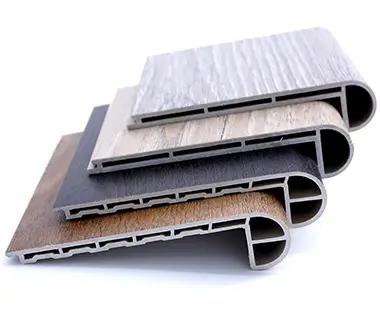
Why Do SPC Flooring and Stair Treads Have Color Variations?
 Are Foam PVC Rolls Suitable for Home Use?
 Why SPC+IXPE Outperforms SPC+EVA, LVT & Bare SPC?
 How Is SPC Flooring Packed for International Shipping?
What are the three plastics of PVC, PE and PP? Let a professional PVC floor supplier tell you!
☛Introduction to Polyvinyl chloride
Polyvinyl chloride (PVC) PVC material was invented quite early, and it is widely used in industrial products. Because PVC also has the advantages of other plastic materials, and it is excellent in processing and plasticity; it is cheap and widely used.
Applied to pipes, profiles, building materials, wire and cable sheaths, etc. In addition, PVC film has good heat shrinkability, and is widely used in box packaging and bottle labels. PVC has a certain flame retardancy, and it will extinguish itself when the fire source is removed.
Polyvinyl chloride has high specific gravity, flame resistance, high transparency, good insulation and good printability. Different formulations have different characteristics, widely used and cheap. When the processing temperature exceeds 190°C, it is prone to cracking and releases HCl gas. The molecular weight is between 60,000 and 150,000, and it has good electrical resistance and fire resistance.
☛Introduction to polyethylene
Polyethylene (PE) is the most widely used plastic in industry and life. It is generally divided into two types: high-density polyethylene (HDPE) and low-density polyethylene (LDPE). HDPE has a higher melting point and higher hardness than LDPE. More resistant to erosion by corrosive liquids. PE has excellent resistance to acidity and alkalinity. The plastic bags and various translucent or opaque plastic bottles currently on the market are almost all made of PE, such as detergents, shampoos, shower gels, edibles, etc. Oil, pesticides, etc., are mostly packed in HDPE bottles. Identification method: Most of them are opaque, feel like wax, and there is a rustling sound when the plastic bag is rubbed or rubbed.
High-density polyethylene (HDPE) (density 0.950-0.965) can be produced by low-pressure gas-phase or liquid-phase through medium-pressure and low-pressure methods. HDPE is a hard thermoplastic. In terms of hollow molded products, most of them are made of HDPE, and only a few of them are made of LDPE. As for the application of HDPE materials in pipes, it competes with PVC pipes and metal pipes for the market.
Low-density polyethylene is produced by high temperature and high pressure method, low density polyethylene (LDPE) (density is 0.915 ~ 0.930), LDPE is a semi-rigid thermoplastic. LDPE film is frequently challenged by PVC and PP materials in terms of application, especially in shrink and stretch packaging, which is substitutable.
LDPE is ubiquitous in modern life, not because of the containers it's made of, but because you see it everywhere—plastic bags. Most plastic bags and plastic films are made of LDPE. Containers made of LDPE are mostly translucent if no coloring is added, such as milk bottles, film boxes, etc.
☛Introduction to polypropylene
Polypropylene (PP) is polymerized from propylene. Similar to polyethylene, it has greater mechanical strength and higher melting point (about 165°C). One hydrogen atom in polyethylene is replaced by methyl (methyl, CH3) .
Advantages: light weight, chemical resistance and heat resistance; Disadvantages: poor impact resistance at low temperature, difficult to be painted or adhered by adhesives and glass fiber reinforced molding surface is not smooth.
Polypropylene offers a balance of properties and price that is unattainable with most thermoplastics. Polypropylene is easy to form and has good chemical resistance and mechanical properties.
Polypropylene is mainly used in the automotive industry, household appliances, plastic ropes, carpets, shoe heels, and for kitchen and bathroom equipment, pipes; transparent films for packaging and wrapping paper for wrapping fresh food. Its low flammability and breathability make it very suitable for making sportswear, and some high-quality horns are also made of polypropylene, especially car horns; its high strength makes it suitable for making car bumpers.
Compared with PE, PP has more rigidity and heat resistance. It is often used in food packaging. It will make a rattling sound when pinched by hand. It is widely used in disposable lunch boxes and milk tea cups.